Total Pageviews

Saturday, October 27, 2012

Losing Your Lunch

photo credit unknown 


     A few years ago my husband and I went to see "Four Christmases" starring Vince Vaughn and Reese Witherspoon.  We are kind of like that couple, happy to be on our own most of the time and really enjoy that time.  The scene that had me practically on the floor, laughing hysterically was the "low gag reflex" scene, in which a baby spits up on Reese and Vince almost loses it as well.  He says, "You gotta get outta here, (gag) I'm sorry (gag), I love you, but I'm gonna do it, too! (gag)" when she's the one who should be gagging!
     I get it.  I am exactly the same way.  Early in my career, a new teacher (me), gullible, and naive, and didn't want to be, didn't let a child go to the nurse because she thought the child was faking it.  After all, he had just come in from recess during which he'd been playing handball and was just fine.  Sure....now recess is over and you don't feel good, uh, huh.  Well, that doesn't work with me, mister!  I didn't actually say that, of course, but if there were thought clouds following me around...
    Five minutes later he vomited, luckily it was on the linoleum and not on the carpet or desks, and most importantly, not on my feet!  Well, he warned me, after all.  I am ashamed to say, I had the exact same reflex as my friend Vince.  I love you, go away!  I'm gonna do it toooooo!  I managed to control myself by breathing through my mouth and not looking at it, trying to keep the others from going crazy.  It was the mid-1990s and we had yet to have phones in the rooms and relied on that big box on the wall called an "intercom."
     I told the child to go to the nurse and I called ahead on the intercom to warn them that a vomiting child was on the way.  We went outside for fresh air, me acting like it's no big thing, just a little throw up, we all do that sometimes, let's be sensitive...la, la, la.  That was my first, but not last, encounter with vomit.  Oh to be the janitor at an elementary school.  Bless the janitors.
     From that incident I learned a very important lesson:  "throw up" "my tummy hurts" and anything that could result in a child vomiting, is the magic get-out-of-class card.  So the years went along, for the most part I was successful in escaping all forms of bodily fluids including urine, feces, snot, blood, etc., by simply making the child deal with it (in a nice way, of course).  I never say "no" when a child asks to go to the bathroom, even it it's 10 minutes after recess has just ended.  It's like they know, they have a sixth sense for my fear of vomit and use it their advantage, they know, somehow, like the Children of the Corn, that I will keep my distance and not invade their private realm of uncontrolled spewage.
     So, many, many years later, as my dream class was happily, politely, and sweetly working on a math activity, the sweetest, most charming little girl, who had no symptoms, no hints, no inkling that she was sick, projectile vomited all over her table.  I witnessed it in slow motion and instantly flashed to my childhood viewing of The Exorcist.  When she was done, and we all realized what had happened, she did it again.  There was so much vomit, I was dumbfounded as to what to do but I knew if I got even a whiff I would gag, and that would crush her.  I summoned my innermost, deepest, strength that I didn't even know I had, breathed through my mouth and avoided the sight I had just seen, and calmly told the others to go outside right now and sit at the tables (so grateful the courtyard has a few snack tables right outside my door).  For reasons unknown, they all did exactly that.  Without giggling, smirking, or exclaiming, "Eeeewwww, grooooosss!"
     I came back inside to a shocked and embarrassed little girl and my heart cracked for her.  I called the nurse (really, the office, who has a full time nurse anymore?) and notified them that this girl was coming up and why.  I needed clean up, so I had to call for that.  It sure seemed like the janitor took his time, probably because I was traumatized and not anything to do with his urgent desire to clean up a disgusting mess.  I actually tried to help but nothing was salvageable.  We scooped everything on the table into a trash can and I took the rest of the kids to early recess.
     Not two days later, a different child did the exact same thing while in line to leave the room.  There was no heads up, no warning whatsoever, but the difference was that this time, he had perfect timing and rocket- vomited right as he walked past me on his way out the door to recess.  The worst thing?  Some of it landed on my semi-new, awesomely comfortable, Dansko sandals.  Ok, those cost over $100 and now I'm mad!  No, not really, but yeah, I was, but no, I can't be mad at him, he's 6, so I handed him a trash can and sent him to the office (are you sensing a pattern here?).
     Since then, there have been no other incidences, except those in other people's classrooms, to report.  These types of incidences are the reasons I shop at Target and Kohl's for clothes anymore.  Who wants to get vomit on their new outfit from Nordstrom's (can't afford Nordstrom's anyway, but still)?  The other day, last week, a sweet little girl came up to me, crying, because her stomach hurt "bad."  I whipped out a note to the office so fast one of those tears never even made it to her cheek.
 
   Take a tip from me:  Beware of sweet, innocent little girls!


Wednesday, October 24, 2012

Super Sentences

     I was unsettled about the Runaway Pumpkin activity from Friday, mostly because it seemed too hard for about 7 students.  I wanted to re-teach the art of a super sentence so as I drove my 45 mile commute, I mulled, which, actually, is a great time to think up some really powerful lessons.
     Some background is that my team of four first grade teachers recently attended training on how to GLAD-ify our teaching, meaning make language more accessible to all students (well, focused on ELL, but in first grade they are all acquiring language).  One of the strategies is sentence patterning.
     A sentence patterning chart and subsequent activities are extremely powerful.  Students are taught about the parts of speech in an informal way.  For now, they are being taught the pattern of adjective, noun, verb, and prepositional phrase, and we use the academic language peppered with the definition to make it more understandable.
     We, my first grade level team, call a sentence "super" if it follows this pattern because it gives more information to the reader.  To extend, I add a little editing portion once they've "finished" (in quotes because I'm forever being told, "I'm done") and shared out that in order to make it "perfect" check for a capital, spaces, and period.  It's so cute when they all at once turn their heads toward their papers to fix errors!
     So after weeks of supported, scaffolded, and guided sentence building based on the sentence patterning chart, I was more than a little dumbfounded.  Why was it so hard?  After mulling, I decided it came down to mechanics and not enough support.  Those seven students were bogged down by poor fine motor skills, lower ability in phonemic awareness, and general lower ability than the rest.  Differentiation, re-teaching and more practice was clearly needed.
     I am very pleased with my re-teach lesson, as they all were successful without having to have much assistance from me.  To begin I wrote three super sentences on the board and I had them "turn and talk" about which words were the adjectives, which the noun, etc.  So I underlined the parts of speech in the color coded fashion that is GLAD.  For example, "The black cat zoomed through the living room."  Once they'd decided, I chose volunteers to say which was which.  I proceeded with two more sentences.  Then I erased and drew the colored lines on the board without any words, but reminded them which was which and wrote that in the academic language.  I then had them "turn and talk" about a sentence they could make up and share.
     They came up with fabulous sentences!  So much oral work is what was missing from my Friday lesson.  To guide toward independent practice, I put a picture of a pumpkin up on the digital projector so they could go to their seats and write a sentence, but wait!  When I put the picture up...

photo credit unknown
 ...I had them put their heads together in their teams to come up with a pumpkin sentence that followed the pattern.  I then called on the numbered head (kids are assigned a number within their team) to report out a sentence.  They came up with, "The orange pumpkin is sitting on the balcony,"  "A fat pumpkin is sitting on a bus seat."  "The orange pumpkins are sitting on a mat."  I gave feedback for each one, honoring their creativity.
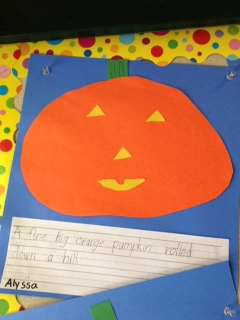
     Here is what they made on their own papers:

This student had a very hard time during Friday's lesson.  When I got to her, she was already halfway done! Her pumpkin sat on the window sill.

This student needed support from me, as his paper had no spaces between words.  I helped him sound out as well. His pumpkin fell off the slide at school.

This activity was easy for this student.  He could have added more, but was content to have it done and color. His pumpkin sat on the vine.

This girl had a very original idea!  That is a balcony and she wasn't sure about her spelling of  "pumpkin" so she marked it with an sp.

In the amount of time it took some to write one sentence, this student was finished with three.

     You can see that classes have an enormous array of ability levels.  Finding the right balance so all can be successful and not bored sure is a balancing act!  

Saturday, October 20, 2012

Runaway Pumpkin


     October = Pumpkins.  Yippee!!

     Pumpkins are always a high interest topic so many (all?) teachers use them to the fullest in language acquisition, reading, writing, math, you name it.  This year, we are focusing more than ever on writing "super sentences."  The art of building a super sentence lies with the use of adjectives, fantastic verbs, and interesting prepositional phrases.
     I selected The Runaway Pumpkin by Kevin Lewis because it was on my shelf, but also because the author uses language that goes just enough beyond a child's knowledge base so that it enriches vocabulary in a way that's memorable and fun, but it's not so far advanced as to cause their eyes to glaze over.  When asked to describe pumpkins, first graders will typically say "orange," "big/small," "cool."  Their vocabulary isn't exactly mesmerizing.
     By using this story as a base for vocabulary development, I can get students to say and use words like big, orange, round, fat, fine, thumpin', bumpin', and runaway to describe their pumpkins!  In addition, the pumpkin in the story zooms, bounces, rolls, and speeds down a hill, causing all kinds of destruction  (we all love witnessing destruction, right!?) to the characters' parents' chicken coop and pig sty as it rolls down the hill.
     Using an adjective before a noun doesn't come naturally to six year olds, neither does using a capital, spaces and ending punctuation, but that's another story.  Once the scaffolding was done and we'd practiced building sentences orally, it was still a challenge for many to construct a truly "super" sentence, but it was well worth the effort.
     Here are some of the results:

This student struggled and had to start over, but he reveled in the applause that came when he shared out.

This student really loves the word "zoomed!"  I will work with her more when constructing a super sentence.

This student really got the adjective aspect!

    The Lesson

    To begin, I read the story for enjoyment.  They really got into it!  Then when I read it again, I told them to listen for words that tell what pumpkins are like.  "Pumpkin" will be our noun, so these are words that tell about pumpkins, they were told.  We made a list on the board.  Then we came up with four actions that happened as the runaway pumpkin rolled down the hill.
     Once we'd done some oral work with the words (the most important part in my opinion), I gave them a graphic organizer with a pumpkin in the middle and four vines with big leaves coming off its stem.  In the middle of the pumpkin they were to write the noun (pumpkin) and on the leaves, adjectives from the board.  This is where I should have concluded until the next session, but nooooo.   Nothing went wrong, I just sensed the energy level waning.  But no worries, it all worked out.
     When it was time to transition from the graphic organizer to the sentence writing, most could do it!  I was so happy.  There were also many who struggled, but with a little help, were able to be successful.
     Their reward for hanging in there, for doing hard things and not giving up, was to make a pumpkin with scissors, paper, and glue.  They loved it!
     The next time I do this lesson (next year) I will make some changes. I'd break it up into smaller lessons, mostly, and I'd do more with the oral practice before moving into writing anything.
   

     I don't have the graphic organizer right now, so I'll scan and add it to the post next week.  You can easily make one, though, by drawing a pumpkin, vines, and leaves big enough to write a word inside.


Saturday, October 13, 2012

Hot Rod Hamster


     I discovered the hot rod hamster 3 years ago, when I saw it in the Scholastic Book Order.  I just thought he was cute, so I got it with bonus points.  It turned out to become one of my favorite lessons to teach.
     Hot Rod Hamster, by Cynthia Lord, is a darling story about a little hamster who sees a sign for a hot rod race posted and wants to join it.  So he goes to the junkyard and the dog who lives there helps him pick out all the stuff to build his hot rod.  It, of course, has flames, and he, of course, must wear a helmet.  But needless to say, fun and excitement ensue once the race starts!  This is one of those books that causes children to shout, "Again!"
     So over the past 3 years, I've tried different variations of math lessons involving hot rods.  I ran off some cars from the Harcourt Brace Blackline Masters Teacher Resource book (quite a useful tool if you use your imagination).  Each student got 12 to cut out and use as counters to model subtraction stories.  Once everyone was ready and the scraps were out of the way, we began.
     I am the first to tell stories, "4 hot rods are racing around the track (make vroom-vroom sounds) but then 2 hot rods screeched off the track! (make screeching sounds), they have been taken away, are gone and not coming back, do we have more hot rods or fewer hot rods?"  Honestly, this sounds completely unnecessary, but you'd be surprised at just how many students tell me "more" and want to add 2 hot rods.  After a few more and after checking for understanding, I let students tell their stories for us all to model on our workmats.


      There is usually a lot of talking and my gut reaction is to make them quiet down, but really, they are talking about math, so I have to quell that urge and it's hard!  Last year, I had an idea right in the middle of the lesson to turn on the digital projector and type their stories as they told them.  They became more focused, more quiet, and I think they got more out of it.  But if you don't have a projector hooked up to your computer, the lesson still works fine.
     After recess, I like to end the lesson with an activity that utilizes the counters further.  I don't like to have pieces sitting out, unused, so I have them draw a racetrack, decide how many hot rods to start with and how many crashed, no blood or death please (again, you'd be surprised.  Or maybe you wouldn't).  Once that is complete, students must write a number sentence to match.  Many of them will write 4-6=10, so this is a fantastic way to see who gets it and who doesn't.  Ta-da!!  Teachable Moment...


If you would like the hot rods and workmat packet freebie click here:  http://www.teacherspayteachers.com/Product/Hot-Rod-Hamster-Subtraction-Activity

Monday, October 8, 2012

B I N G O !

     Kids love candy and I've definitely tapped into that.  I know.  I'm guilty of perpetuating the food reward system that is very much a part of all of us.  We eat when we're happy, we eat when we're sad and need comforting, and we eat for everything in between.  I justify my candy rewards with the fact that my students get ONE Starburst or ONE Skittle or ONE Hershey's Kiss when they win.  I sandwich in the rewards of a stamp on the hand and a "smelly sticker" (candy flavored lip balm that is rubbed on the back of a hand brings smiles like you'd never believe) to assuage my guilt.  Let's face it, if we played Bingo and I said they could have an apple when they win, I'd get a nice view of scrunched up faces and moans.
     Students in first grade LOVE playing games.  If it weren't for games, learning anything wouldn't be very fun or memorable.  I'm always making something on the computer for the kids to do, like the game of Bingo. I never save my files, just print and use, then I lose it, and have to make it again the next time.
     Not anymore!  Since I discovered Pinterest and through Pinterest, Teachers Pay Teachers (just recently), I've actually put a lot of thought into making sets of Bingo games (in my head) that would be easy for teachers and parents to do with kids.  I just have to make them on the computer, save them, fix errors, save again, upload to TpT, monkey around with thumbnails that won't generate, previews that won't work, and link the listing to Pinterest, my blog and Facebook (I'm not on Twitter...yet).
     So here it is...

     See, the thumbnail isn't there, so here's the jpeg: (the picture is not a link)

EnjoY!


Saturday, September 29, 2012

Teachers Pay Teachers


My first Teachers Pay Teachers item for "sale" is free.  That's ok!  When I saw that a kindegarten teacher, Deanna Jump, made $1 million on the site, I thought, "Hey, I have great lesson plans, too, I could make some money!"

I'm always making worksheets on the computer to use in my classroom anyway.  From now on, I'll make them at home and decide if I think someone else might like them as well.  I plan on making a whole slough of Bingo and other game boards that foster learning at a deeper level.

So wish me luck!

http://www.teacherspayteachers.com/Browse/Search:primary+bingo

Sunday, August 19, 2012

I'm GLAD to be a teacher!

     I met my new class on Thursday and spent two days with them before the weekend.  Starting on a Thursday is genius.  It's just enough time to get a little done then rest up over the weekend and be ready for five full days the following week.
     I'm fresh off a two day (out of six total) GLAD (Guided Language Acquisition and Development) training and boy was my head swirling with mixed feelings!  I was jazzed and excited about the new things I learned, yet my secure and comfortable world as a first grade teacher was slightly rocked.  The trainers made it look so easy.  This, combined with my new obsession with Pinterest, had me in a state.
     I'm not averse to trying new ideas, so I dove in.  They talked about a way to get the students' attention without being intrusive.  They modeled how to simply put your hand up in the air (I usually ring a bell or clap) and wait for students to notice and copy you.  Raising hands are supposed to travel throughout the room like a wave at a baseball game.  Well, that lasted about a 1/2 day.  It wasn't really working and I don't like being ignored, so I went back to ringing a bell.  Bell rings,  Hands Up.  That's better.
     On Day One, I read a story called Jitter Juice, about a person who is nervous about going to school on the first day.  As we read, students thought they were hearing about a child who was nervous, but when they discovered it was the teacher, they were surprised.  So after a little vocabulary development (big words for figuring out what "jitter" means), I poured some Fresca out into cups and passed it out.  Here is what I was treated to during the next ten minutes:

"OK, I'm going to pass out some soda, it's lemon lime, but right now it's just soda, so wait until we turn it into Jitter Juice!"

Child:  "But I don't have the jitters."

"Well, goooooood!  You can have some Jitter Juice anyway so you don't get them later."  What behavior am I teaching here???

Child 2:  "I don't want any Jitter Juice.  I don't like lemon lime."

"Ok, I'll give you some anyway so you'll have in case you change your mind."  Hopefully, I'm teaching her to be open to new things (?).

     I smiled and shook my head "yes" slightly.  My little technique to get kids to do what I want.  Sometimes it works.
     The rest of the kids were having fun and so was I.  The best part was when it was time to transform it into Jitter Juice. I had gotten grape Kool Aid and poured it into a teeny tiny cup and called it Jitter Juice Powder.  As I walked around the room, I sprinkled a tiny amount into their cups and reveled in the "oohs" and "aahhhs" I heard.

"It's turning purple!"

"It's just Kool Aid."  Thank goodness nobody really wanted to hear that.  Children are uncanny in shutting each other down.  In this case, I liked that.

"It's swirling around!"

"It's turning into Jitter Juice!"

    Once we all sang the chant we learned during "Vocabulary Development" they chugged it down. But when I saw them do that, I thought to myself:

"OMG they look like they're doing shots."  Crap.  All we needed were some quarters, put a bucket in the middle of the tables, and we'd be set.  Jitter Juice Par-tay!

     When a teacher tries new things, sometimes it goes beautifully and sometimes it goes unexpectedly.  This was unexpected, but not the end of the world.  They loved the Jitter Juice and asked for more, but that's when I snatched the wonder and beauty of the Teachable Moment:

     "No, we can't have too much or we won't feel good.  We have to know when enough is enough."  Yeah, right.  I'd sure like a shot (or two) of tequila right now...with some lime, perhaps, especially because now they were making those empty plastic cups crack and pop in their hands.  Plus, I only bought one bottle of Fresca, justified through reasoning that a little bit of artificial sweetener was better than sugar in the middle of the day.  Must get those cups in the trash can...
    I tried a few other GLAD strategies on the second day and I know the minor mistakes I made, but the kids don't, nobody was harmed, and that's really what matters.
     I will finish my GLAD training during Labor Day week, where I will see the many, many strategies I learned about in action in an actual classroom with actual kids.   In the meantime, I will fumble around, work harder not smarter, be outside my comfort zone for a little while, and carry on.

If you are interested in Project GLAD, here is a link to the website:

http://www.projectglad.com/